We study the recovery of high-dimensional tensors with approximately low-order ANOVA structure, with guarantees on the worst-case recovery error. Our work advances the theory of optimal recovery and provides a practical framework for applying these methods to real-world high-dimensional data.
Jingchun Shao
Mathematics · Texas A&M University
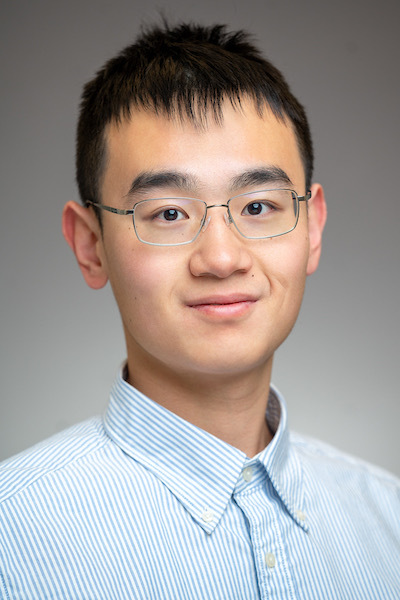
I’m a Ph.D. student in Mathematics at Texas A&M University, advised by Professor Simon Foucart. I study computational methods for high-dimensional problems arising in science and machine learning.
I’m particularly interested in understanding how hidden low-dimensional structure arises in complex systems, and in developing efficient algorithms that discover and exploit this structure. My current work focuses on tensor methods, compressed sensing, and optimal recovery.
Before joining Texas A&M, I received an M.S. in Computational and Applied Mathematics from the University of Chicago, where I worked with Professor Yuehaw Khoo, and a B.S. in Pure and Applied Mathematics from Hunan University.
Selected research
Storing and recovering finely discretized signals can be prohibitively expensive. This paper studies how low-rank quantized tensor-train representations and sparse low-order interactions enable recovery from limited measurements. It establishes conditions for unique recovery and develops a provably accurate initialization whose measurement requirement grows polynomially with tensor order for fixed structural parameters.